g

8 minutes Not all water in a house goes down the drain - unfortunately some of it ends up staying in or around the home causing timber to rot and wall damage. In other cases it is high humidity (water in the air) causing dampness when the humid air cannot escape. Below we show where to look for common water and dampness problems - check these locations always. Where there are damp problems on a home, always get an idea of the repair cost and use this to negotiate the price.
Seen on the lower part of a wall up to approximately 1m above ground, it is usually caused by water rising from the ground into the wall. A break in the the damp proof course (a layer near the ground in a wall that prevents water rising) is a common cause. Can be remedied by injecting chemicals into the wall or repairing the damaged DPC.
This is when water horizontally moves through a wall - if you have a heap of clay with garden plants against a wall, water will enter the wall. You can resolve it buy removing the cause (the clay in this case).
Lets say we have air at room temperature and it has water in it in the form of vapour - it is invisible and lets say it is at 50% Relative Humidity (RH). That means the air is carrying 50% of the water that it is capable of carrying at that temperature. If we lower the temperature the RH increases. An RH of 100% would mean that the air is carrying the maximum amount of water for a particular temperature and condensation starts to happen. When hot air hits a cold surface, RH increases and you get droplets of water. This is condensation dampness and can often be seen on bathroom walls after a shower and kitchen walls during cooking. A fan can reduce this problem as it sucks the damp air outside.
If we have a source of damp warm air such as a bathroom and this air escapes in to a cold attic, the air will cool and insulation and timber surfaces in the roof will have condensation. This can be called Interstitial Dampness as the dampness happens within the structure of the house. Correct ventilation in the bathroom and attic will stop the problem.
If there is insulation pushed against the roof underlay and touching it, interstitial dampness can occur on the underside of the underlay which is a cold surface. To avoid this, a gap can be left under the underlay by using 'Rafter Trays' or similar eave vent systems.
Dry rot tends to exist in lower levels of humidity / dampness compared to wet rot. Each is a different type of fungus but wet rot tends to be local to the source of the dampness while dry rot can travel across brickwork and cause substantial damage. Good ventilation that reduces humidity is the easiest way to prevent rot with prompt action to resolve leaks.
If there is a meter fitted, take a reading and turn off all taps and the heating system. If the meter keeps turning, you either have a water leak somewhere from that meter towards the property or you could have a shared mains pipe with a neighbour - check with the neighbour or the house seller and then start checking the house for signs of a leak. If there are no obvious signs, it could be under the floors or externally in the ground - the seller will need to hire a leak detector to discover where.
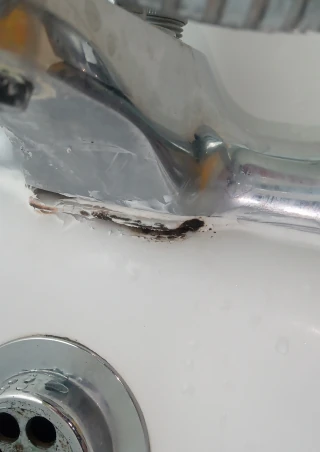
Sinks have seals under the taps to stop water splashes leaking through the holes where the taps are fitted - if the seals rot or leak, you will have drips (usually hidden) onto the wood under the taps, at the rear of kitchen cupboards or floors under the bath/shower. Check around the edges of all sinks and baths to make sure they are sealed and under kitchen and bathroom sinks and bath if possible.
Check the waste pipes for washing machines and dishwashers and ensure that they have not been flooding over - it is caused by clothes fibres building up in the waste pipe. These waste pipes are often not sealed and as the leak is random, you should check floors in the vicinity for stains or warping.
All drains at the bottom of the sinks ('traps') should have water in them at all times - if there is no water ('dry trap'), there could be a leak. Traps can dry out due to central heating or bad design where the water is sucked out (when a toilet is flushed for example) so just turn on a tap and fill the trap - if it empties you have a problem. Waste gases from the sewer may also enter if the trap is dry - see House Buyer Tips - Finding the source of smells in a house.
A radiator leak tends to be obvious but if the pipes are leaking under the floor, it is invisible. Detecting the problem is fairly simple - check if the pressure of the water at the boiler drops off during your inspections with the heating on - larger leaks will cause the pressure to drop. (it will be a visible dial on the boiler with red/green markings).
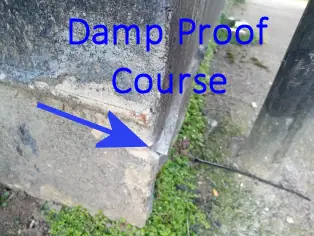
Damp proofing is a barrier introduced in a wall above ground level that prevents moisture moving upwards through bricks from the ground. The 'course' is the barrier layer and it can be made from laying slates horizontally on the bricks as the wall is being built, using hard 'engineering bricks' at ground level or various layers of plastic/bitumen. If it is damaged moisture travels upwards into the bricks above and it can cause internal dampness or external wet bricks. If there is obvious damage, it can be replaced by opening the area and placing a new patch of DPC or a chemical can be injected into the wall to seal the area although this method is not fully effective always.

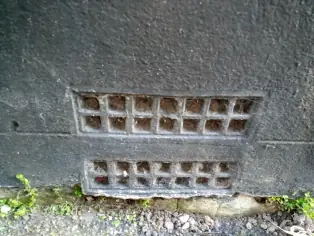
Air bricks allow ventilation into the brickwork and under-floor which carries away moisture in the air. If they are blocked the dampness that comes through the outer part of the wall (leaf) cannot escape and it enters the internal wall as dampness. Floor boards will rot if they are damp for long periods of time. Solve by cleaning or replacing air bricks.
Air bricks should be about 75-150mm above ground level to avoid flood water entering under the floor boards - if air bricks are at ground level, you should check floor boards for rot.
Air bricks below ground will not allow free air movement and water may enter during rain - this happens when patios or raised driveways are built.
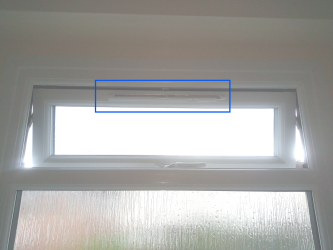
Trickle vents allow damp air to slowly exit to the outside through natural (passive) airflow. This reduces high humidity in rooms such as bathrooms or bedrooms which causes dampness and staining on walls. Closing trickle vents in winter to reduce heat loss causes dampness. They only became obligatory in the last few years and may not be in older windows but they can be retrofitted cheaply.
There are 2 types of ventilation - passive as seen in airbricks and vents where air moves through natural flow and active where a fan forces air movement. If a fan is out of use, it can't do it's job to remove air and if it is in a bathroom or kitchen, smells and humidity increase quickly with wall staining. Always check fans when viewing a house!
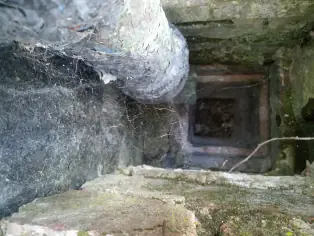
With a cracked or broken gully, the rainwater or waste coming from your kitchen / bathroom sink leaks into the surrounding soil and will weaken the ground at foundation level. You may end up with cracks in a wall if it causes subsidence (ground movement). In some cases the gully will dry out and there may be drain smells coming from the main sewer. This problem must be repaired quickly.
With this system, the outer walls are completely covered and sealed with an external insulated layer. If there are any tiny gaps in the insulation layer such as at the top near the roof or sides, water may enter and become trapped between the wall and the insulation. This can cause noticeable internal smells and dampness. Many government funded external wall insulation projects are faulty and have caused dampness. Have a builder or qualified surveyor inspect as it is specialist work to repair.
As flat roofs age, they are exposed to constant changes in sunlight, temperature and rain. Joints in the material, wall edges and seals around chimneys or vents are common areas with internal localised ceiling / wall staining. Water puddles on the roof can indicate 'bubbling/delamination' (when the various layers of a roof separate and rise up).
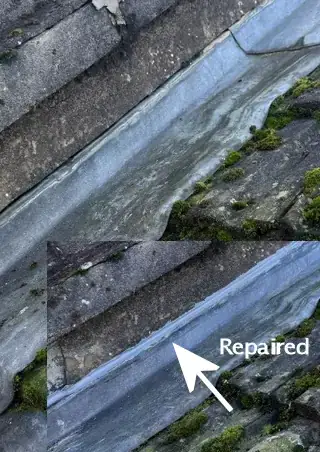
Almost impossible to see from the ground but if you can enter the attic you may see daylight or water staining where slates/tiles are damaged. Brown / black spots on a ceiling may appear. Lead flashing that has loosened or is incorrectly sealed may also allow water in as will deterioration of the sealing at the wall.
When blocked or leaking, the rainwater will splash against the wall and just under the roof sometimes causing damp stains on the inner side of the wall and staining on the outside. This can also be caused by the gutters being undersized with water splashing over the edges during rain - a simple solution is to change to deep high capacity gutters.
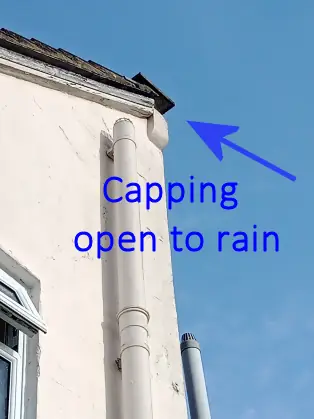
In some houses, the roof is partially surrounded by an external wall (parapet) which has a 'capping' on it to prevent rain entering the wall. If this capping is loosened or the concrete which seals it in falls away, rain carried by wind will enter under the capping. This drops down the wall and can show up as dampness.
A soakaway or 'soak away' is a hole in the ground that has been dug and then filled in with stones. The top visible area is often covered with grass or paving and the soakaway is invisible to the eye. Rainwater or kitchen wastewater is piped to the hole rather than a public drain and over time, the water soaks away into the ground. Ideally they should be placed at least 5m from the walls of a house or your neighbours property.
Years ago they were built nearer to walls and dampness or structural problems can occur. Over time, sediment from gutters can also block up a soakaway causing the effective size to reduce and flooding will happen. Ask the seller if there are any on the property always.
Any splash from the tap or drip will go directly to the ground rather than into a drain. This can cause dampness issues or in extreme cases, problems with the foundation if the tap drips constantly. Install a gully or move the tap.
Green areas including gardens are being concreted or paved over. Rainwater cannot soak into the ground and instead flows away causing random flooding often onto neighbouring land. In addition, careless installation of rainwater pipes on home extensions with the rainwater wrongly directed to a neighbours roof or property is happening more often. Generally if water flow is 'natural' from a neighbours property during or after rain, you must accept it but if the water arrives because it was piped or directed onto your property, you have a cause for complaint (Buying a home - are you buying a property dispute?).
It can be very difficult to find the source of dampness or water below ground in a basement. If dampness is just caused by stale (non-moving) air, you can fit a fan to ventilate the area. If there is a cable or pipe entering through a wall, it may not be sealed correctly in the wall and water can enter around it - sealing these points is relatively cheap.
Sealing or 'tanking' the walls and floor is another solution. There are various sealing plasters and paints applied to the wall that aim to keep the water from entering and causing mould but always remember that the walls still are damp.
Another well know system is a cavity drain - you essentially build an internal wall from plasterboard leaving a small gap (cavity) between it and the existing wall - a plastic sheet with dimples (membrane) is fitted in the gap and the water falls to the floor where it is pumped away. It is the more expensive solution.
Insulation prevents heat loss but the water in the air (humidity) has to be released or you will have condensation and dampness. There should be roof vents to allow the damp air to leave.
Yes is the answer! The roof fan should connect to a pipe and that pipe should be connected to a roof or wall vent where it the air can exit outside. If the pipe is leaking or non-existent, you may have dampness in the roof or on the ceilings near the roof fan.
last updated December 11th, 2025